Our Story
The tiny settlement of Taylorstown is nestled in the scenic, rolling farmlands of Virginia’s northern Loudoun County, an area regarded as one of the most beautiful rural regions of the state. It is situated on the banks of Catoctin Creek, a meandering stream which formerly supplied power for the village mill. About two miles north of the community, the stream joins the Potomac. The wooded Catoctin Mountain is immediately to the east of Taylorstown; most of the remaining property in the vicinity is open farmland dotted with patches of forest. Little commercial development has taken place to mar the pastoral quality of the area.
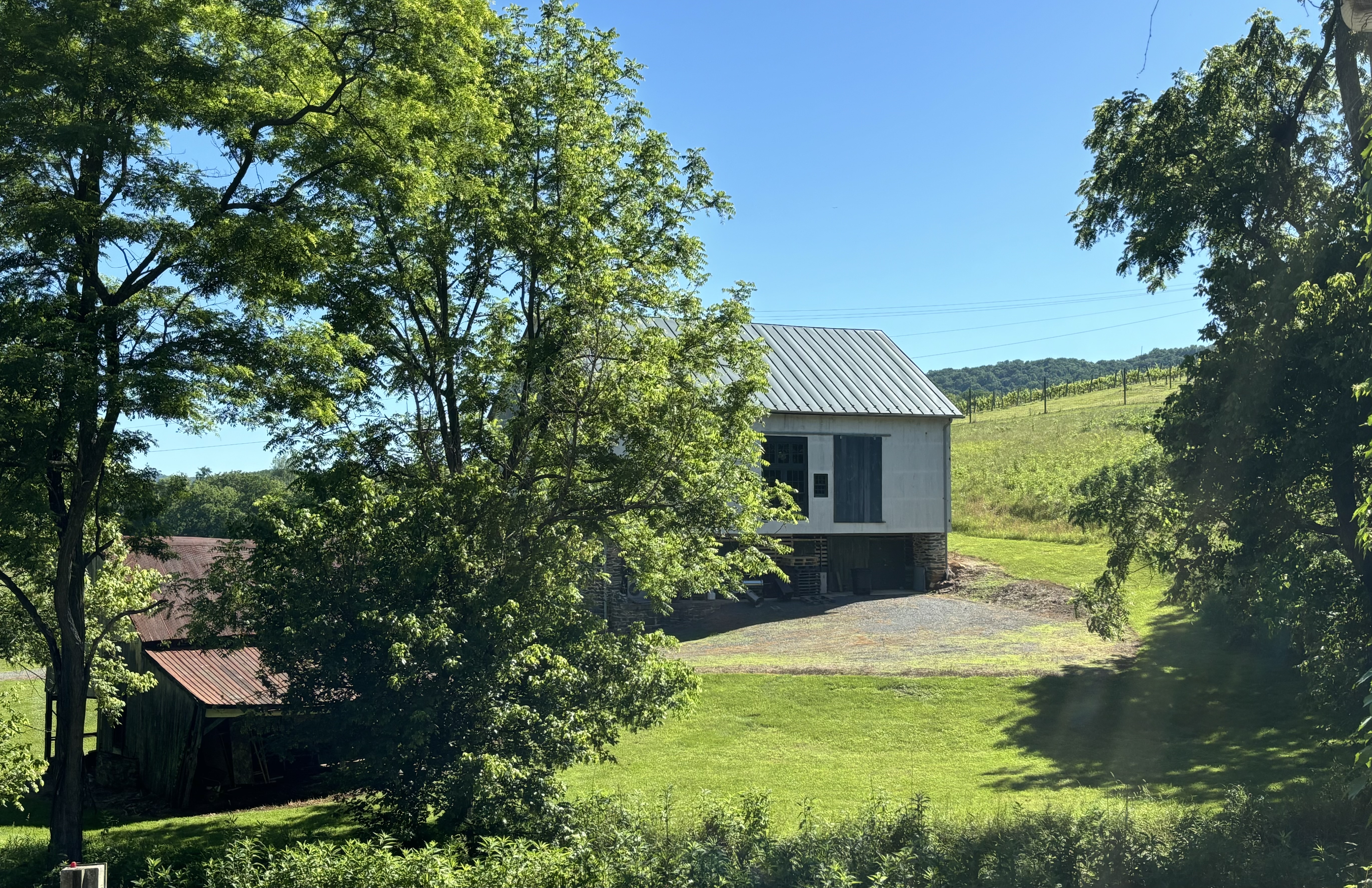
Although numerous milling communities survive across the state, few possess a setting so scenic or a collection of vernacular buildings of such interesting diversity as the tiny hamlet of Taylorstown. Even in its minuteness, the historic village has an ambiance of a quality rarely retained in similar communities. The origins of Taylorstown are traced back to the 1730s when the settlement of northern Virginia began. In that decade English Families from the tidewater region and German and Quaker families from Pennsylvania began moving into what was to become Loudoun County. There, the Germans occupied much of the northern section, while pockets of Quakers were established around Waterford, Lincoln, and what is now Taylorstown. The Taylorstown site offered a convenient ford across the Catoctin Creek and a steady supply of water power. Thus, in the 1730s the Quaker Richard Brown started a milling operation there and established a farm on the property now known as Hunting Hill. The present house at Hunting Hill may have been built in 1737, the date traditionally assigned to it, as its dimensions conform to those escribed by Lord Fairfax, the proprietor of the region, for settlers taking up land there.
In 1784. Richard Brown’s son, Mercer Brown, sold the mill and family farm to Thomas Taylor of Frederick County, Maryland, who probably built the present stone mill. The original mill erected by Brown most likely was a log structure as were the majority of the earliest mills in the region. Taylor acquired with the mill a log miller’s house which has since disappeared. After establishing himself, Taylor began selling off half-acre lots near the mill. The resulting small community came to be called Taylors Town, and later Taylorstown. The Taylor family lived at Hunting Hill and operated the mill for the next forty-five years. The last owner to continue the milling operation was Millard C. Myers, who ran the mill from 1912 to 1958. Today the mill is used as a private residence.
Although the mill has ceased its operation the tiny village, composed of less than a dozen structures, remains unspoiled by either neglect or modern intrusion and all the structures remaining in the town possess some degree of architectural interest. The mill is also a rare survival, as the majority of mills in Loudoun County, a county once known for its many mills, have disappeared. Taylorstown Mill indeed is one of the handful of such structures in the state that has been successfully adapted for a new function; most of the early mills across Virginia stand idle and abandoned.

Of Taylorstown’s other buildings, the eighteenth-century stone cottage known now as Foxton is a quaint example of Loudoun’s early vernacular. Likewise, the ca. 1800 town store, although much altered, is a rare example of village commercial architecture of its period and an important element in the mill complex. The Mann’s Store is an interesting specimen of early concrete construction with decorative surface treatment. Built in 1904 to replace an earlier building on the site destroyed by fire, the present structure has its concrete walls scored with deep vee joints to make the walls appear to be laid in very formal ashlar stonework. The Mann and Rollins houses are both typical and well-preserved examples of late Victorian vernacular dwellings. Their white walls and fancy sawn-work porches add a festive note to the now sleepy village. Intertwined among all these buildings are well tended, old-fashioned landscaped yards which, with the beautiful pastoral scenery surrounding the community, contribute to make Taylorstown a rural historic district of exceptional visual quality.
Catoctin Creek is presently spanned in the village by a modern concrete bridge of little visual interest. It replaces a metal truss bridge taken down within the past ten years, which was located just to the south of the present bridge, close to the mill. The stone abutments of the former bridge were left in place. Except for the new bridge and a scattering of new houses south of the main intersection along Route 665 (not included in the historic district), Taylorstown has suffered few modern intrusions. The historic buildings, and the scenic open spaces between them, form a picturesque, visually cohesive unit.
(Taken and abridged from the National Register of Historic Places Inventory 1978 Nomination Form)
 Taylorstown Community Association